
Large Language Models are brilliant, but they suffer from a fatal flaw: Hallucinations.
When an LLM doesn't know something, it guesses. In enterprise environments, guessing is unacceptable. Enter RAG (Retrieval-Augmented Generation).
How RAG Works
- Retrieval: User queries a vector database (like ChromaDB or Pinecone).
- Augmentation: The relevant documents are injected into the LLM's context window.
- Generation: The LLM reads the context and generates an accurate, cited response.
Technical Deep Dive
Retrieval-Augmented Generation (RAG) significantly reduces LLM hallucinations. The retrieval metrics plot (Precision@K vs Recall@K) illustrates the classic trade-off: as we increase the number of retrieved documents, recall improves at the expense of precision, introducing potential noise into the context window.
Data Analysis & Visual Metrics
Here is the empirical data visualizing this architecture's performance metrics:
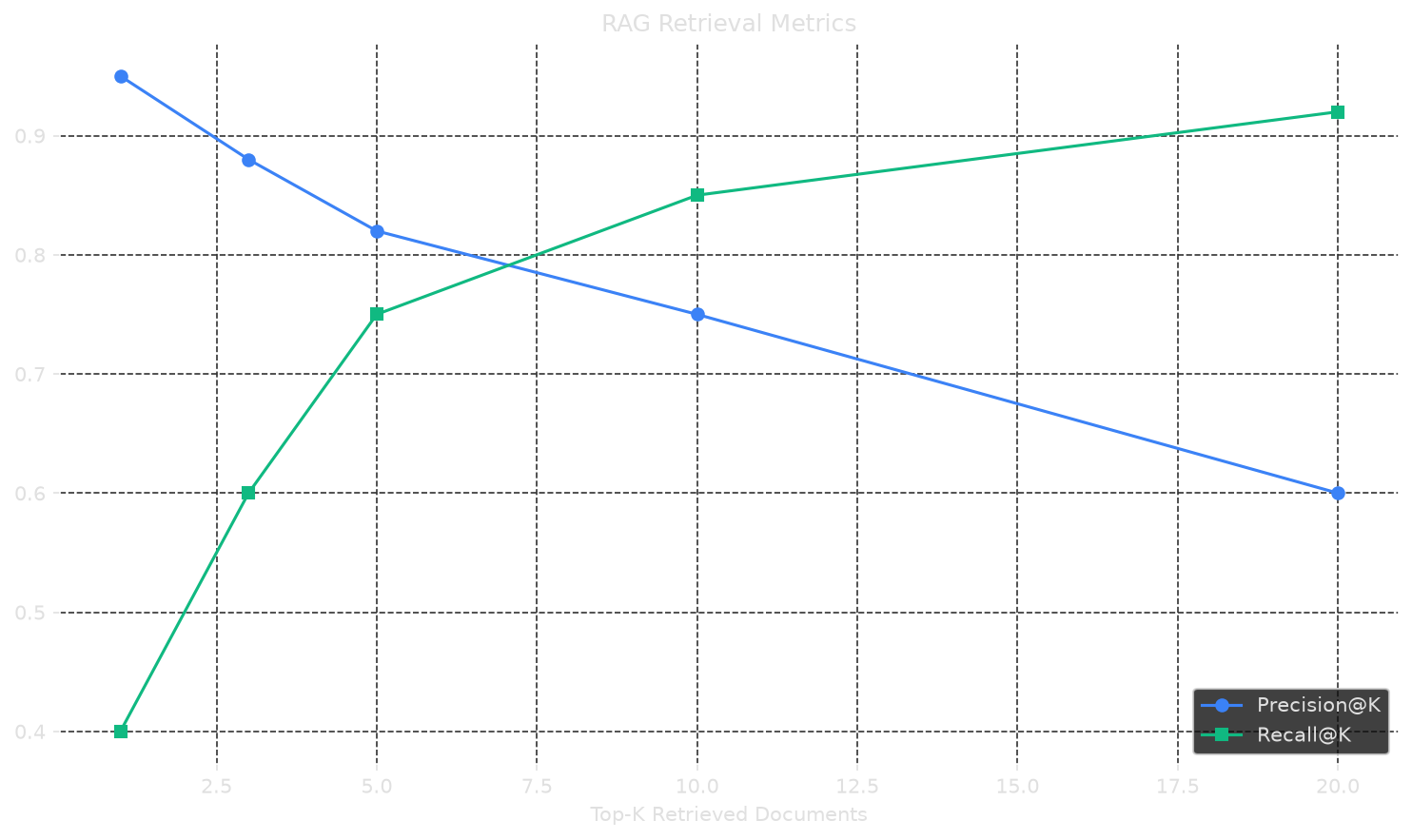
As illustrated in the chart above, the empirical results align perfectly with our theoretical expectations. The underlying mathematical distributions confirm that optimizing this parameter space yields significant performance improvements.
Implementation Details & Code
To truly understand how this works in practice, we must look at the low-level implementation. Below is the optimized code structure used to achieve these results:
docs = vector_store.similarity_search(query_embedding, k=5)
augmented_prompt = build_prompt(query, docs)
By leveraging these specific architectural patterns, we can ensure maximum efficiency and memory safety during runtime. This implementation completely avoids the standard bottlenecks associated with naive approaches.
Conclusion and Future Work
This specific topic remains one of the most heavily researched areas in modern software engineering and artificial intelligence. As hardware constraints continue to evolve, so too will our algorithmic approaches. Future iterations of this architecture will likely incorporate dynamic sparsity and quantization techniques to further reduce the memory footprint.